Best Coast

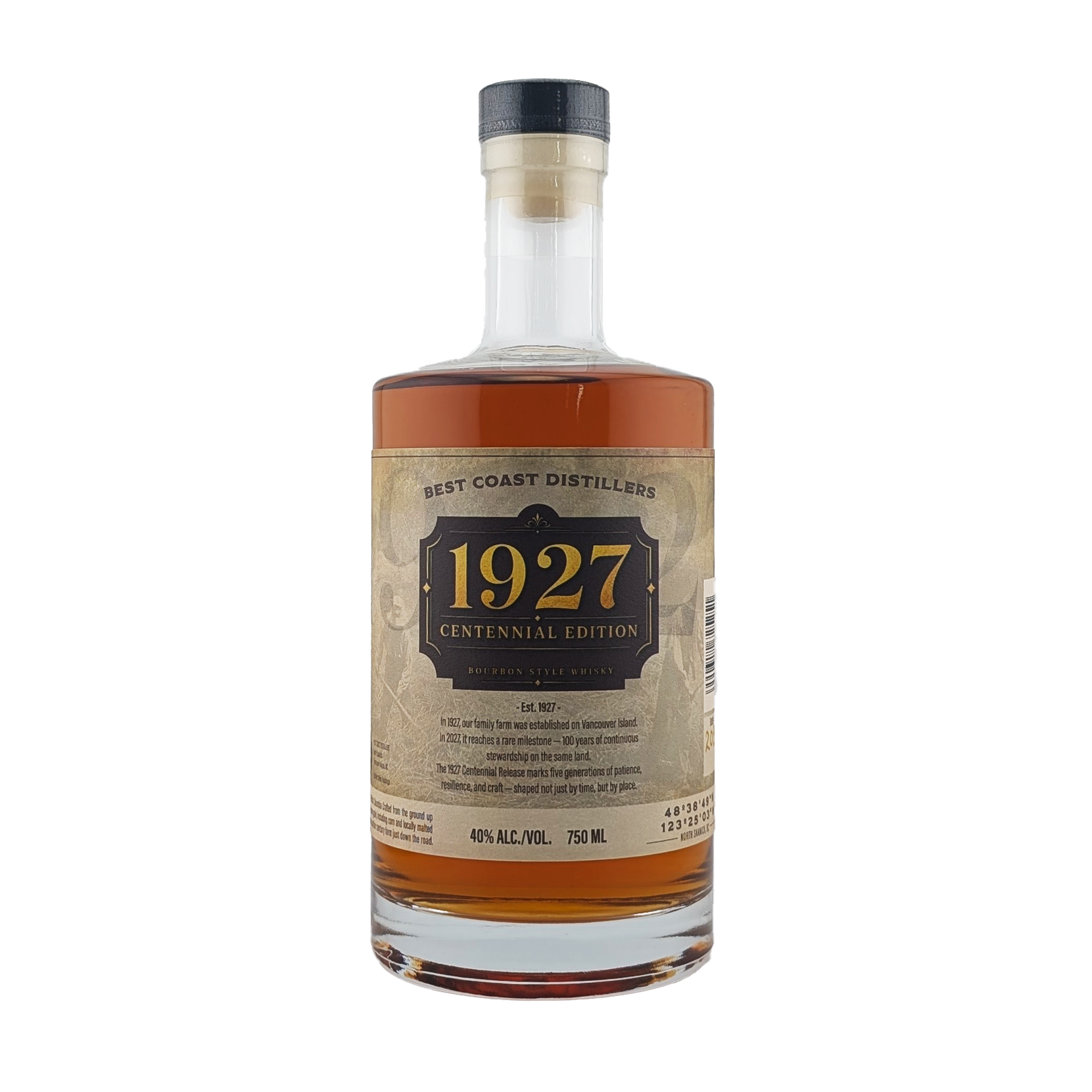
1927 Centennial Edition Bourbon Style

40% ABV • Whisky • 750ml • 10+ In Stock

Bourbon Style from BC in Canada

$92.96 + tax and deposit
$83.66 for Whisky Folk Members
Featured Whisky • Members Save 10%

SOLD OUT

14 in stock

Available for in-store pickup, local delivery, and Canada-wide shipping. Click here for details.

PRODUCER
Best Coast

BOTTLER
Official Distillery Release by Best Coast Distillers

AGE
3 Years Aged

CASK TYPE
Custom Charred Virgin American Oak

RELEASE
Standard Single Cask Release

CHILL-FILTRATION
Unknown

ADDED COLOUR
No

PEAT SMOKED
No

Adam’s Notes

Even before the current Canada and USA trade issues, I’ve historically had a somewhat tumultuous relationship with bourbon. This was, of course, somewhat awkward for a person with almost two decades of experience in the whisky industry, especially during the massive boom in popularity that bourbon has seen in the last decade.

I should start by saying that I thoroughly enjoy it as a beverage. A good bourbon is an absolutely delicious experience. The quintessential spectrum of flavours that are commonly found in this strictly regulated style of whisky are ones that just seem to naturally go together. Caramel, vanilla, cinnamon, orange peel, pecan and cherry. All things that sound like the backbone of a stunningly harmonious dessert.

So where’s the issue? Well, that harmony often comes at a cost – a lack of complexity and a lack of variation. The same rules that make sure the whiskies almost always turn out great also tend to make them rather similar. This is not to say that they are the same by any means. Two of my favourite traditional, well-known bourbons are Old Grand-Dad Bonded and Evan Williams Bottled-in-Bond. And while I can definitely tell the difference, with Old Grand-Dad tending more toward cinnamon and orange and Evan Williams usually being more vanilla and cherry, the scope of variation tends to be limited.

I longed for the dissonance and surprise that you often find in other styles of whisky. Where are the exciting discoveries of passionfruit, fresh cut grass, or beeswax? Where are the weird notes of old coffee grounds, creosote or beef stock that shouldn’t work but oddly do?

In the last half-decade or so, I’ve discovered several bourbons that have strayed from the more formulaic approach and opted for a touch more creativity. With unusual mashbills and maturation techniques, distilleries like F.E.W., Boulder, Oppidan, and Kings County pushed the restrictions to their limits and unlocked a level of complexity that I didn’t know was possible within the category. And honestly, the new level of diversity in flavour gave me an increased appreciation for the more traditional products as well. I really feel like producers such as Michter’s, Buffalo Trace, and Four Roses are releasing some stunningly high-quality whiskies these days.

Ironically, after finally discovering my own path to embracing the bourbon style, I’m now in a place where I am no longer either buying it or selling it. Poor timing on my part, I guess. While I am one hundred percent on board with our decision to halt the import and sales of American liquor and concentrate on supporting our own domestic products, I do honestly miss my exploration of bourbons.

I apologize for the rather long-winded background information here, but I had to set the scene properly for what happened a couple of weeks ago. Because to me, it was truly remarkable. Let’s get to the main event and talk about the 1927 Centennial Edition.

I arrived at work after a couple of days off to find a bottle of whisky on my desk. This in itself is not unusual. I am in the business of selling whisky after all. What was surprising was that I didn’t really know what it was. I didn’t recognize the bottle at all. After looking at the label, I realized that it was from Best Coast Distillers. A relatively new distillery up in North Saanich, and one that I’d been meaning to take the time to go and visit. Something that sadly, I’ve still yet to do at the time of writing.

I have, however, learned more about the product in that time. It’s a bourbon in every way except for its place of origin. The mashbill, distillation and maturation are all in line with the style’s regulations. The mash bill is just corn and barley (which excites me greatly), and the casks are proper American Standard Barrels made especially for them with custom char levels. In fact, many of those processes and the barrels themselves are the result of a well-timed holiday. A story that I shouldn’t share myself, but hope to have told on our YouTube channel one day if the distillery accepts my invite for an interview tasting.

So the only thing making it not a bourbon is the location in which it is distilled, matured and bottled. However, the location is perhaps the most interesting part of the story behind this bottle, and is indeed the inspiration for the name 1927. The distillery is located on a farm that has been owned by the Hastings family since that very year, and one of the founders of the distillery just happens to be the fifth-generation caretaker of that farmland. The family settled in North Saanich after leaving their former home in California. If they’d just stopped a few miles further south on the other side of the Canadian border, then this would be very much considered bourbon. But as those of us who live here know, Vancouver Island is a very special place, and I can’t blame the Hastings at all for ending up here.

Okay, back to the day I found that bottle on my desk. When I poured myself a sample of it, I have to admit my expectations were not high. I’ve been burned before by distilleries’ first releases. Some show great promise, but rarely do they actually deliver on their first swing. And this isn’t a local thing; this is a global phenomenon. But as my nose reached the glass, something quite unusual happened. My senses were taken back in time about four years, to when I first started to truly understand and appreciate bourbons through those aforementioned smaller producers.

I didn’t have the forethought to make notes of my findings right then and there. Instead, I gleefully took the bottle around the building and poured it blind for several of my colleagues. This was in part to see if they picked up that it was a bourbon style without being told (most did), and frankly, to make sure I wasn’t going mad and that it was actually as good as my first impressions indicated. Now that the dust has settled, and I’m sat alone with a decent-sized pour – here’s my experience.

All of the basic bourbon hallmark aromas are there, especially the vanilla and orange peel. But they were joined by a delightfully bright anise note. This feels somewhat unexpected as anise is usually a darker flavour to me, but this is a bright and playful addition that is just the right amount to supplement the driving flavours without changing their direction dramatically. And it’s a trilogy of flavours that work particularly well, something I discovered when I first arrived in Canada and tried Tiger Tail ice cream for the first time. With more time spent in the glass, the more unique side of this whisky starts to come through, with toasted sage and hawthorn leaves and a touch of dusty, sun-damaged leather.

The palate starts soft with brioche doughnut notes, and reminds me somewhat of the more wheated mashbill bourbons that I’ve had. Curious, as there isn’t actually any wheat in this one. As the flavour builds, it gains a few fruitier notes that verge on the slightly sour side. Gooseberries perhaps, or maybe even lime juice. Then comes a quick hit of sweetness that reminds me of fairground cotton candy. Then finally it settles back down into a creamy peach custard note that fades into cold brew coffee with brown sugar.

If there is one thing that I would say that could be a negative, it’s that it was bottled at 40% abv. I tend to prefer a bit more concentration in my bourbons, and I know that bartenders will also be looking for that when it comes to making cocktails. But that being said, this is still a fabulous experience even at 40% – and it makes me very much look forward to future releases that I’ll do my best to persuade them to up the proof on.

This is an absolute triumph of a first release in my eyes, and I love that both Cory and Corey (which I assume will get pretty confusing) from Best Coast have been so incredibly humble and a delight to speak with. I brought in a few cases to The Strath, which I expect won’t last very long – especially as that bottle that mysteriously landed on my desk is now available for our club members to swing by and try for free.
Adam’s Notes

Even before the current Canada and USA trade issues, I’ve historically had a somewhat tumultuous relationship with bourbon. This was, of course, somewhat awkward for a person with almost two decades of experience in the whisky industry, especially during the massive boom in popularity that bourbon has seen in the last decade.

I should start by saying that I thoroughly enjoy it as a beverage. A good bourbon is an absolutely delicious experience. The quintessential spectrum of flavours that are commonly found in this strictly regulated style of whisky are ones that just seem to naturally go together. Caramel, vanilla, cinnamon, orange peel, pecan and cherry. All things that sound like the backbone of a stunningly harmonious dessert.

So where’s the issue? Well, that harmony often comes at a cost – a lack of complexity and a lack of variation. The same rules that make sure the whiskies almost always turn out great also tend to make them rather similar. This is not to say that they are the same by any means. Two of my favourite traditional, well-known bourbons are Old Grand-Dad Bonded and Evan Williams Bottled-in-Bond. And while I can definitely tell the difference, with Old Grand-Dad tending more toward cinnamon and orange and Evan Williams usually being more vanilla and cherry, the scope of variation tends to be limited.

I longed for the dissonance and surprise that you often find in other styles of whisky. Where are the exciting discoveries of passionfruit, fresh cut grass, or beeswax? Where are the weird notes of old coffee grounds, creosote or beef stock that shouldn’t work but oddly do?

In the last half-decade or so, I’ve discovered several bourbons that have strayed from the more formulaic approach and opted for a touch more creativity. With unusual mashbills and maturation techniques, distilleries like F.E.W., Boulder, Oppidan, and Kings County pushed the restrictions to their limits and unlocked a level of complexity that I didn’t know was possible within the category. And honestly, the new level of diversity in flavour gave me an increased appreciation for the more traditional products as well. I really feel like producers such as Michter’s, Buffalo Trace, and Four Roses are releasing some stunningly high-quality whiskies these days.

Ironically, after finally discovering my own path to embracing the bourbon style, I’m now in a place where I am no longer either buying it or selling it. Poor timing on my part, I guess. While I am one hundred percent on board with our decision to halt the import and sales of American liquor and concentrate on supporting our own domestic products, I do honestly miss my exploration of bourbons.

I apologize for the rather long-winded background information here, but I had to set the scene properly for what happened a couple of weeks ago. Because to me, it was truly remarkable. Let’s get to the main event and talk about the 1927 Centennial Edition.

I arrived at work after a couple of days off to find a bottle of whisky on my desk. This in itself is not unusual. I am in the business of selling whisky after all. What was surprising was that I didn’t really know what it was. I didn’t recognize the bottle at all. After looking at the label, I realized that it was from Best Coast Distillers. A relatively new distillery up in North Saanich, and one that I’d been meaning to take the time to go and visit. Something that sadly, I’ve still yet to do at the time of writing.

I have, however, learned more about the product in that time. It’s a bourbon in every way except for its place of origin. The mashbill, distillation and maturation are all in line with the style’s regulations. The mash bill is just corn and barley (which excites me greatly), and the casks are proper American Standard Barrels made especially for them with custom char levels. In fact, many of those processes and the barrels themselves are the result of a well-timed holiday. A story that I shouldn’t share myself, but hope to have told on our YouTube channel one day if the distillery accepts my invite for an interview tasting.

So the only thing making it not a bourbon is the location in which it is distilled, matured and bottled. However, the location is perhaps the most interesting part of the story behind this bottle, and is indeed the inspiration for the name 1927. The distillery is located on a farm that has been owned by the Hastings family since that very year, and one of the founders of the distillery just happens to be the fifth-generation caretaker of that farmland. The family settled in North Saanich after leaving their former home in California. If they’d just stopped a few miles further south on the other side of the Canadian border, then this would be very much considered bourbon. But as those of us who live here know, Vancouver Island is a very special place, and I can’t blame the Hastings at all for ending up here.

Okay, back to the day I found that bottle on my desk. When I poured myself a sample of it, I have to admit my expectations were not high. I’ve been burned before by distilleries’ first releases. Some show great promise, but rarely do they actually deliver on their first swing. And this isn’t a local thing; this is a global phenomenon. But as my nose reached the glass, something quite unusual happened. My senses were taken back in time about four years, to when I first started to truly understand and appreciate bourbons through those aforementioned smaller producers.

I didn’t have the forethought to make notes of my findings right then and there. Instead, I gleefully took the bottle around the building and poured it blind for several of my colleagues. This was in part to see if they picked up that it was a bourbon style without being told (most did), and frankly, to make sure I wasn’t going mad and that it was actually as good as my first impressions indicated. Now that the dust has settled, and I’m sat alone with a decent-sized pour – here’s my experience.

All of the basic bourbon hallmark aromas are there, especially the vanilla and orange peel. But they were joined by a delightfully bright anise note. This feels somewhat unexpected as anise is usually a darker flavour to me, but this is a bright and playful addition that is just the right amount to supplement the driving flavours without changing their direction dramatically. And it’s a trilogy of flavours that work particularly well, something I discovered when I first arrived in Canada and tried Tiger Tail ice cream for the first time. With more time spent in the glass, the more unique side of this whisky starts to come through, with toasted sage and hawthorn leaves and a touch of dusty, sun-damaged leather.

The palate starts soft with brioche doughnut notes, and reminds me somewhat of the more wheated mashbill bourbons that I’ve had. Curious, as there isn’t actually any wheat in this one. As the flavour builds, it gains a few fruitier notes that verge on the slightly sour side. Gooseberries perhaps, or maybe even lime juice. Then comes a quick hit of sweetness that reminds me of fairground cotton candy. Then finally it settles back down into a creamy peach custard note that fades into cold brew coffee with brown sugar.

If there is one thing that I would say that could be a negative, it’s that it was bottled at 40% abv. I tend to prefer a bit more concentration in my bourbons, and I know that bartenders will also be looking for that when it comes to making cocktails. But that being said, this is still a fabulous experience even at 40% – and it makes me very much look forward to future releases that I’ll do my best to persuade them to up the proof on.

This is an absolute triumph of a first release in my eyes, and I love that both Cory and Corey (which I assume will get pretty confusing) from Best Coast have been so incredibly humble and a delight to speak with. I brought in a few cases to The Strath, which I expect won’t last very long – especially as that bottle that mysteriously landed on my desk is now available for our club members to swing by and try for free.
More From Best Coast

Other Best Coast Distillers Releases

Whisky Folk Review

As sampled by our members

The below is the average score out of 5 from our members, and the flavour profile which was voted to be the most prominent.

Review This Whisky

Whisky Folk Flavour Profile(Required)
Select between 1 and 3 choices.

Please input your score with up to one decimal place.

Join The Club

Whisky Folk is free to join and can start saving right away!

Join 1200+ other members and join our Whisky Folk community. Enjoy in-store samples, special exclusive releases, interactive tasting events, and 5-10% off on all regularly priced whiskies!